Cloud computing is regaining popularity as businesses rethink how they construct programs, store data, and manage expenses. From startups to large companies, the option frequently boils down to three major providers: AWS, Azure, and Google Cloud. You are not alone in looking for a AWS vs Azure vs Google Cloud comparison PDF. Many IT teams and students desire an easy method to evaluate features, cost, and real-world scenarios.
Key highlights
- AWS, Azure, and Google Cloud dominate the global cloud market
- Each platform has its own strengths and pricing style
- Market share trends in 2025 show steady competition
- Free comparison PDFs are widely available online
- The “best” cloud depends on your needs, not just size
What are the top 3 cloud platforms?
The top three cloud platforms are Amazon Web Services (AWS), Microsoft Azure, and Google Cloud Platform (GCP). Together, they control most of the global cloud infrastructure market.
AWS is known for its early start and wide service range. Azure integrates deeply with Microsoft products. Google Cloud stands out for data analytics, AI, and machine learning tools.
Most comparison guides, including any AWS vs Azure vs Google Cloud comparison PDF free download, focus on these three because smaller providers simply don’t match their scale or service depth.
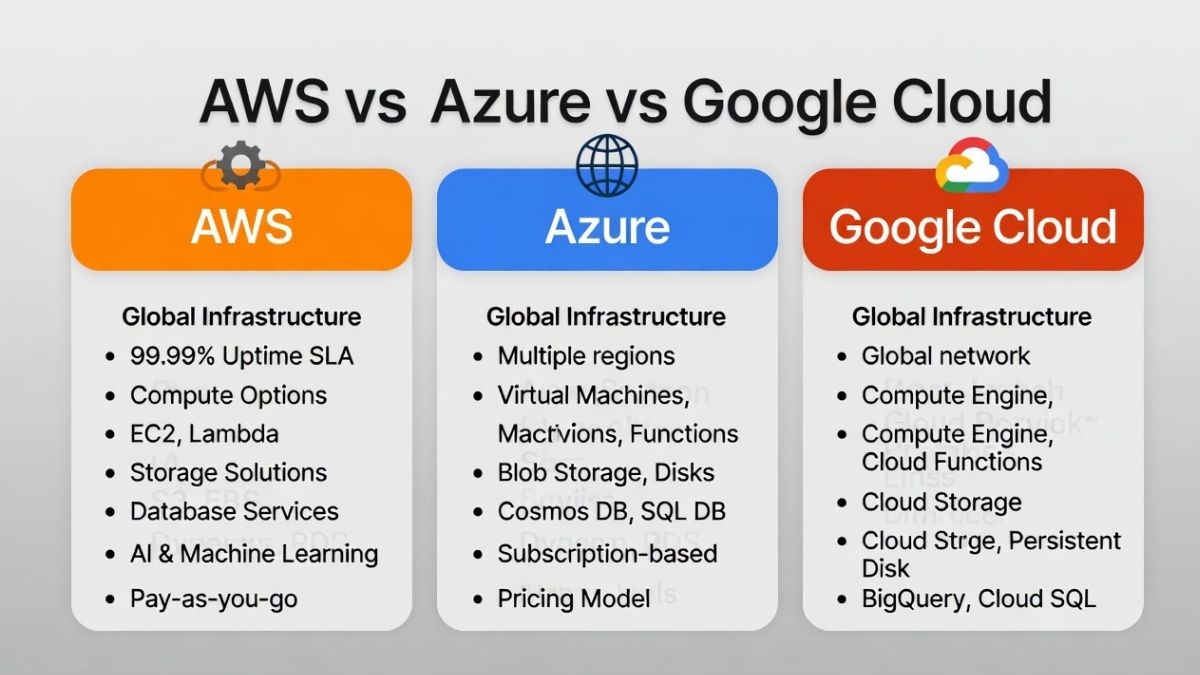
AWS vs Azure vs Google Cloud comparison table
An AWS vs Azure vs Google Cloud comparison chart is frequently the simplest way to see the differences at first sight. While the specifics vary, most tables compare computation, storage, networking, databases, and pricing methods.
AWS often provides the broadest range of services. Azure emphasizes hybrid cloud and enterprise technologies. Google Cloud maintains a narrow portfolio while delivering outstanding performance and analytics.
These tables are prevalent in PDFs and blog posts because they enable users to rapidly match features to their requirements.
AWS vs Azure vs Google Cloud terminology explained
Understanding AWS vs Azure vs Google Cloud terminology can be confusing at first. Each provider uses different names for similar services.
For example:
- Virtual machines are called EC2 (AWS), Virtual Machines (Azure), and Compute Engine (GCP).
- Object storage goes by S3, Blob Storage, and Cloud Storage.
- Serverless computing appears as Lambda, Azure Functions, and Cloud Functions.
Most comparison PDFs include a terminology section to help beginners avoid confusion.
AWS and Azure services comparison chart
An AWS and Azure services comparison chart is especially useful for businesses already using Microsoft tools. Azure works smoothly with Windows Server, Active Directory, and Microsoft 365.
AWS, on the other hand, offers more customization and global infrastructure options. Charts comparing these services often show Azure ahead in enterprise integration, while AWS leads in service variety.
These charts are commonly included in downloadable comparison PDFs for quick reference.
AWS vs Azure vs Google Cloud comparison PDF 2020 and 2022
If you’ve seen references to AWS vs Azure vs Google Cloud comparison PDF 2020 or AWS vs Azure vs Google Cloud comparison PDF 2022, you might wonder if they’re still useful.
Older PDFs are useful for examining how prices and services have developed. However, cloud systems evolve quickly. Features from 2020 may appear extremely different now.
For current decisions, utilize updated PDFs or guides that reflect current pricing, performance, and geographical availability.
AWS vs Azure vs Google Cloud market share 2025
Market share in 2025 still shows AWS in the lead, followed by Azure, then Google Cloud. AWS holds the largest share due to its early entry and broad customer base.
Azure continues to grow, especially among enterprises already invested in Microsoft software. Google Cloud, while third, has been gaining ground in data-heavy and AI-focused projects.
Market share alone doesn’t decide quality, but it does reflect trust, ecosystem size, and long-term stability.
Is AWS better than Google Cloud?
The question “Is AWS better than Google Cloud?” doesn’t have a single answer.
AWS is often better for:
- Large-scale global deployments
- A wide range of managed services
- Mature third-party integrations
Google Cloud is often better for:
- Data analytics and big data workloads
- Machine learning projects
- Competitive pricing for specific services
Your choice depends on what you’re building, not just which platform is bigger.
Pricing and availability
All three platforms use pay-as-you-go pricing. Costs depend on usage, region, and service type.
AWS pricing can be complex but flexible. Azure offers discounts for existing Microsoft customers. Google Cloud is known for simpler pricing and sustained-use discounts.
All platforms are available globally, with data centers across major regions.
How to buy or get started with a cloud platform
You don’t “buy” cloud services like hardware. Instead, you start an account.
Here’s how:
- Choose AWS, Azure, or Google Cloud.
- Create a free account.
- Use free-tier services to test.
- Compare costs using calculators.
- Scale up when ready.
Many comparison PDFs include step-by-step onboarding guides.
FAQs
1. Where can I find an AWS vs Azure vs Google Cloud comparison PDF free?
Many tech blogs, learning platforms, and vendor sites offer free downloads.
2. Are old comparison PDFs still useful?
They help with history, but newer ones are better for decisions.
3. Which cloud is cheapest?
It depends on usage. Google Cloud often wins for analytics, Azure for Microsoft users.
4. Do I need coding skills to use cloud platforms?
Basic knowledge helps, but many tools are beginner-friendly.
5. Can I use more than one cloud?
Yes, many companies use multi-cloud setups.
Choosing between AWS, Azure, and Google Cloud does not involve picking a single winner. It’s all about tailoring the platform to your workload, budget, and long-term goals. Comparison PDFs are useful beginning points, but true clarity comes from learning how each cloud matches your individual requirements.